Wednesday, May 9, 2012

ROME: Piazza di Basilica di Santa Maria in Trastevere

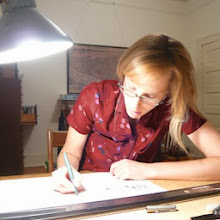
I'm drawn to drawing piazzas. The complexity of space - the variety of facades that form the walls of this outdoor "room", the point around which the space and the people revolve, the entrances and views - compels me to draw in an effort to piece it all together, relationally.


Seeing the space change throughout the day is the privilege of one who lives near the piazza.

ROME: San Pietro in Montorio


Monday, May 7, 2012

ROME: Bird's Eye Beginnings


I've come to ROME to learn the lineage of and try techniques at Birds Eye View Drawings. Having arrived and settled in a bit I scouted the hill behind my Trastevere apartment, the Janiculum, for the View.
I spent hours in the Special Collections library at the University of Virginia looking at hundreds of Maps and Views of Rome, before leaving. Imagine my delight at finding a 1736 View from the Janiculum posted at the Piazzale G. Garibaldi.

I am in for some intense drawing and brought some new tools, inherited from my grandfather when he passed. He was a printer. I have his pens pouch - and was surprised to find in it a clear eraser shield.
But I am SO HAPPY to BE HERE! I'll take the tough work of drawing for the rewards of living in Italy for a month.

I've come to ROME to Draw

DIAGRAM:
top: drawing from distance, apart from
bottom: drawing from within
I've come to Rome for a month, many thanks to the Pelliccia Fellowship from the Architecture School at the University of Virginia. My task is to make drawings, to understand the lineage of the bird's eye view from its Italian beginnings and development since the early Renaissance, and to begin to discover for myself the role of drawing in visualizing history and the contribution of the designer-historian. I will be drawing at two scales or vantages - from a distance, the closest I can find to the bird's eye - and from within a "room", either in a building or an outdoor space enclosed by various "walls." The former is seeking objectivity while the latter seeks the experiential.

Tuesday, May 1, 2012

Houses Against the Grain: The Tour, Charlottesville


What are YOU doing this weekend? It's PRESERVATION WEEK. If you are in Charlottesville VA, consider touring some interesting houses we've researched in the Community History Workshop at the University of Virginia School of Architecture, with Professors Daniel Bluestone & W.G. Clark. The Tour and exhibit at the Albemarle Charlottesville Historical Society were designed by Madeleine Hawks, Camille Behnke, Jessica Lankston, Joanna McKnight, Kim Larson, and Kirsten Sparenborg with research material from other Community History students and community members. 
It's also a featured Jane's Walk!  In the spirit of Jane Jacobs, get out and explore your neighborhood.
http://janeswalk.net/walks/view/houses_against_the_grain/

TOUR MAP

Monday, April 23, 2012

DETROIT is not dead: SAH 2012

click enlarge
I attended the annual conference of the Society for Architectural Historians in DETROIT, Michigan this week. I've been wanting to see Detroit for about 15 years, since seeing some images and becoming aware of the industrial decline and out-migration, all on a massive urban scale. At that time, I was curious about the small towns comprised of weathered and abandoned buildings in rural Virginia that loosely narrated a history of industrial and social change in the nineteenth and twentieth centuries. I followed that pursuit for several years, finally resulting in publication in 2011. Detroit seemed to be the ultimate example of architectural decay and abandonment at a grand urban scale.


At the conference, I learned that these images of Camilo Jose Vergara, Kevin Bauman and Marchand & Meffre which piqued my curiosity and drew me to Detroit were "ruin porn" - and I am guilty. The photos I made of Detroit's downtown depict an architecture of soaring confidence and aspiration - empty and available, juxtapositions between architectural decay and grandeur, proliferation of parking lots and the marks of human expression/exasperation - buildings as canvas.


This was the largest attendance of an SAH conference in its over 60-year history. No big deal, though. Every conference that comes to Detroit lately notes the same phenomenon. People are curious about what's going in Detroit.  I attended all of the paper sessions treating various aspects of Detroit's history and a dynamic session on "Shrinking Cities."  I also attended a roundtable discussion to learn about local city-wide initiatives such as LEAP, spearheaded by community organizer/CEO Maggie DeSantis, focused on improving quality of life in the severely depleted Lower Eastside. Passion and tension were high as Detroit's movers and shakers explained the hopes and challenges of their work and the conference attendees posed questions, generally supportive. One attendee, in shaking voice, asked where all the people were in the plans presented by the panel, including DeSantis, insinuating a lack of humane planning. This woman was exported from Detroit forty years ago because there was no work for an educated woman in Detroit. She found a place in Chicago, but Chicago didn't need her. Don't export any more people, she said. DeSantis blithely responded that she was an educated woman (no doubt) and she stayed. Detroit is a proving ground and can be an incubator for innovative plans for re-imagining this formerly industrial city - but Detroit is not a clean slate where one can do anything. Detroit has a deep history, real dedicated residents with real needs; new-comers thinking outside the box are welcome but they are reminded to be humane and context-sensitive.


Preservation as a tool for healing and re-imagining Detroit threaded through almost every discussion and brought me to some critical questions about the ways preservation might do more than conserve building resources, who was responsible or capable of preserving Detroit's buildings and landscapes, the many scales at which preservation can be deployed and which are most critical, the role of preservation and its dismissal in the city's history. I wondered why, until the past decade perhaps, preservation had little relevance here. It seemed more than other cities, buildings were demolished, easily devalued and thrown away. One conference presenter explained the mentality of Fordism which was constantly striving toward the next innovation and discarding the last, the outmoded translated to the city population's regard fro building as [disposable] resources. Demolishing itself was a sign of progress - either to make way for the next big thing or, in post-war decline, to remove an outmoded scar in the cityscape. An "architecture of optimism." Another presenter, a Detroit activist, educated us on the thick memory of racial division and oppression in Detroit. He explained that these magnificent edifices we might mourn over as they crumble were not mourned by Detroit's black citizens because these were symbols of their dismissal, where they were denied entry or full civic participation.